F-Tags Most Frequently Cited in Nursing Home Surveys
Infection control and food safety dominate citations year after year.

F-tags are the codes CMS surveyors write down when a nursing home falls short of federal care standards under 42 CFR Part 483. They aren't scattered evenly across the regulatory code. They cluster hard around infection control, food handling, medication storage, and care planning, and the same handful of tags appears on the list year after year. That pattern is the story here: the tags that dominate citations aren't random enforcement noise, but a map of where daily operations reliably break down.
A quick note on mechanics before the data: F-tags get recorded on a facility's Statement of Deficiencies whenever a surveyor finds a gap against the Requirements of Participation. Recertification surveys have to happen at least once every 15 months, though the national average interval runs closer to 12. Complaint surveys occur on no set schedule at all, often with almost no warning, and account for roughly one in four deficiencies identified nationally. The penalties tied to a citation scale with how bad the finding is: lower star ratings, civil monetary penalties, more frequent surveys, and, at the far end, loss of Medicare and Medicaid certification.
How deficiency rates have trended over the past decade
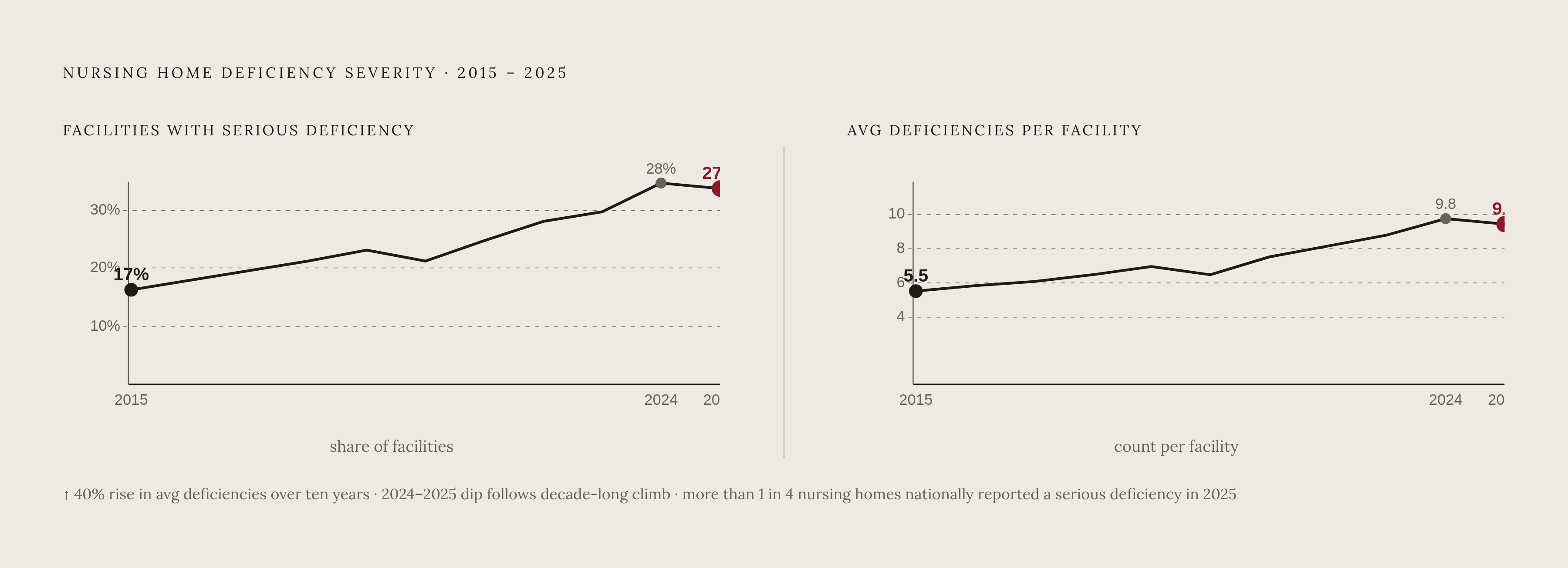
Start with the ten-year line, not the current snapshot. The average number of deficiencies per facility climbed from a level in the neighborhood of the mid-single digits in 2015 to 9.5 in 2025, a jump of about 40%, not a minor shift in the noise floor. That's not a minor shift in the noise floor. It says something changed in how surveys find problems, or how many problems there are to find, or both.
Severity moved in the same direction. The share of facilities reporting at least one serious deficiency rose from 17% in 2015 to 27% in 2025, with a small dip between 2024 and 2025 that hasn't undone the decade-long climb. More than a quarter of nursing homes nationally reported a serious deficiency in the most recent cycle. About 5% of deficiencies in that cycle reached the level of actual harm or immediate jeopardy, roughly 6,700 health deficiencies at that severity. The flip side matters too: 93% of health deficiencies were classified as having the potential to cause harm without actually causing it. Most citations are gaps that could become disasters if nobody closes them. They're gaps that could become disasters if nobody closes them.
2024 and 2025 posted the highest deficiency counts of the entire ten-year window. Facilities operating right now are working inside the toughest survey environment the sector has seen in a decade. The COVID years briefly scrambled which tags topped the list, as surveyors shifted focus toward outbreak response, but the chronic tags reasserted themselves the moment normal survey operations resumed. That reversion is itself a data point: it suggests these aren't fads or artifacts of a particular survey cycle. They're structural.
The current national top-10 list and what moved since 2024
The most recent full national ranking comes from CASPER data. In rank order, the top 10: F880 (Infection Prevention & Control), F812 (Food Procurement, Store/Prepare/Serve Sanitary), F761 (Label/Store Drugs and Biologicals), F689 (Free of Accident Hazards/Supervision/Devices), F656 (Develop/Implement Comprehensive Care Plan), F684 (Quality of Care), F695 (Respiratory/Tracheostomy Care and Suctioning), F550 (Resident Rights/Exercise of Rights), F677 (ADL Care for Dependent Residents), and F584 (Safe/Clean/Comfortable/Homelike Environment).
A more recent regional snapshot shows some churn: F880 and F812 hold the top two spots, consistent with the national list, but F689 moves up to third and F761 to fourth, with F684 and F695 following at five and six. F880 and F812 hold the top two spots, consistent with the national list, but F689 moves up to third and F761 to fourth, with F684 and F695 following at five and six. Four names crack the regional top 10 that don't appear in the April national list: F600 (Free from Abuse and Neglect) at seven, F628 (Discharge Process) at eight, F605 (Right to Be Free from Chemical Restraints) at nine, and F609 (Reporting of Alleged Violations) at ten. F605's appearance coincides with regulatory restructuring CMS put in place in April 2025, covered in detail below.
Stripping out the churn, three tags stand out for sheer durability: F880, F812, and F689 have held top-five positions across both the 2024 and 2025 snapshots, and F684 ranked sixth in both. Those four are the closest thing this list has to a fixed structure. Everything else moves around them.
Why F880 and F812 lead the list every year
F880, infection prevention and control, covers hand hygiene, PPE use, isolation precautions, surveillance, staff training, and outbreak response. Surveyors aren't citing facilities because nobody wrote an infection control policy. Every facility has one. They're citing facilities because the policy isn't followed consistently, or because nobody's tracking whether it's followed. Surveyors dig into surveillance documentation, training records, and how the facility actually responded when an outbreak hit, and a gap in any one of those three areas is enough to trigger a finding. The April 2025 LTCSP update added infection prevention and control to the list of areas with revised surveyor guidance, which only raised the documentation bar further.
F812, covering food procurement, storage, preparation, and service, works the same way. It's about temperature control, cross-contamination, and sanitation discipline in the kitchen, and the citations that pile up usually trace back to lapses in procedure or paperwork rather than staff who don't know the rules. F812 actually dropped out of the national top 10 during the pandemic, when survey attention shifted elsewhere. Its return to the number one or two spot once normal survey operations resumed says something important: chronic vulnerabilities don't go away when nobody's looking, they just wait.
Both tags point at the same underlying issue. These are high-frequency, routine tasks, done dozens of times a day by staff who mostly know what they're supposed to do. The failures are systems gaps, the kind that show up when monitoring is inconsistent or documentation habits slip during a busy shift. They're systems gaps, which appear when monitoring is inconsistent or documentation habits slip during a busy shift. Fixing that requires the discipline to be built into daily operations, not conjured up the week before a survey team arrives.
The medication management cluster: F761, F695, and the evolving landscape around F605
F761 requires that drugs and biologicals be labeled according to accepted professional standards, expiration dates included, and stored in locked, temperature-controlled compartments with key access limited to authorized staff. Most F761 citations trace back to errors made in the rush of a normal shift, not deliberate corner-cutting. A misfiled key, an unlogged temperature check, a label that slipped past a busy med pass: that's the pattern.
F695, respiratory and tracheostomy care and suctioning, is a more clinical tag, and its steady top-10 presence tracks the rising medical acuity of the population nursing homes now serve. These citations tend to involve documentation gaps and procedural adherence rather than outright clinical incompetence. Surveyors hold facilities to an exacting standard here, and the margin for a missed step in a suctioning protocol is thin.
F605, the right to be free from chemical restraints, is the new name to watch. It entered the regional top 10 at ninth place, and its appearance ties directly to the regulatory restructuring CMS put in place on April 28, 2025. Under the revised guidance, F605 gets cited when a survey team determines that an unnecessary medication is functioning as a chemical restraint. At the same time, psychotropic medications were moved out of F758 (formerly the tag for unnecessary psychotropic medications) and folded into F605, while F757 was narrowed to cover only non-psychotropic medications. Overmedication is now treated explicitly as a resident-rights violation, a real shift in framing rather than a cosmetic renumbering. Facilities now need a documented link between a resident's symptoms and the psychotropic medication prescribed, and the revised framework places greater scrutiny on how prescribing decisions are recorded and justified.
Taken together, these three tags show medication management operating on three levels at once. There is a clinical safety concern, a paperwork trail that has to hold up under scrutiny, and, as of 2025, a resident-rights question that didn't carry that weight before.
The resident safety and care quality tags: F689, F684, and F656
F689, covering freedom from accident hazards and adequate supervision, is one of the most consistently cited tags across every source and every year in the data. Citations here involve preventable falls, unsafe equipment, and interventions that don't match a resident's actual risk level. The root cause tends to be the same each time. An environmental hazard nobody flagged, a fall-risk assessment that was never redone, a supervision plan that still reflects how a resident was doing months ago rather than how they're doing now. If a resident falls and the chart doesn't show a current risk assessment tied to a current care plan, that's exactly where a surveyor's attention lands.
F684, quality of care, is deliberately broad. It applies whenever care delivered falls short of professional standards, and in practice it appears most often around delayed responses to a change in a resident's condition, thin documentation, or care teams that aren't coordinating with each other. It ranks higher in some CMS regions than its national position suggests, appearing in the top three in certain areas while sitting around fifth or sixth nationally. The citation, more often than not, is about what the record can prove was given, a documentation failure wearing a care-quality label. It's about what the record can prove was given, a documentation failure wearing a care-quality label.
F656, the comprehensive care plan requirement, ranks in the national top three and does the same in CMS Regions VI (Dallas) and IX (San Francisco). The most common failure is a plan that exists but no longer describes the resident sitting in front of the surveyor: conditions shift, and the paperwork doesn't keep pace. It's a plan that exists but no longer describes the resident sitting in front of the surveyor: conditions shift, and the paperwork doesn't keep pace. The April 2025 LTCSP updates revised care-planning guidance specifically to raise the bar on how current and individualized these plans need to be.
All three tags share a root cause. Staff indifference isn't the driver. The systems meant to track, update, and document a resident's condition over time haven't kept pace with how fast that condition, and the operation around it, actually moves.
Tags that round out the top 10 and signal where regulatory attention is expanding
F550, resident rights and the exercise of those rights, covers autonomy, dignity, and self-determination broadly. Its place in the 2025 CASPER top 10 reflects ongoing surveyor attention to resident autonomy and dignity, themes that also run through other tags on the list.
F677 covers assistance with activities of daily living for residents who can't manage them independently. Citations here usually point to inconsistency across shifts or among staff members rather than any single failure, which makes it as much a staffing-stability and training-documentation issue as a direct-care one.
F584, the safe, clean, comfortable, and homelike environment tag, covers the physical space itself: housekeeping lapses, equipment left in disrepair, hazards in a hallway or a resident's room. It overlaps in practice with F689, since an environmental hazard that hasn't caused a fall yet can still draw an F584 citation on its own.
F600, freedom from abuse and neglect, is among the most serious findings a facility can receive, tied to unreported allegations, investigations that never happened, or safeguards that were never put in place. It doesn't consistently crack the national top 10, but it's been cited on 14.6% of surveys in at least one CMS region, which makes it a pressure point that carries outsized weight wherever it is cited. Between F600's regional intensity and the tightened care-planning expectations behind F656, a pattern is visible: surveyors are pushing harder on documentation that proves a resident's rights and safety were actively protected, not just assumed.
Sources
- ‘Airtight Documentation’ Matters: Inside Upcoming Nursing Home Survey Changes Taking Effect April 28
- Common Deficiencies in Nursing Homes: Understanding the Most Cited F-Tags
- Top 10 Most Frequently Cited Ftags | CMS Compliance Group
- Top 10 Most Frequently Cited Ftags (National) | CMS Compliance Group
- qsource.org
- cdn.ymaws.com
- CMS Unveils Major Changes for Nursing Home Surveys for 2025
- A Look at Nursing Facility Characteristics in 2025 | KFF